From Technology to Strategy: AI through the Lens of CEE Executives
.
From Technology to Strategy: AI through the Lens of CEE Executives
Panel Discussion at TRANSLOG Connect Congress
.
The 2025 edition of TRANSLOG Connect Congress once again welcomed its international audience with a strong line-up of exhibitors, high-level presentations, and a highly structured business agenda. On the second day, industry leaders gathered for a highly anticipated panel discussion titled “AI in Action: Optimising Supply Chains for Efficiency, Sustainability and Resilience.”
Artificial intelligence is no longer a buzzword - it has become a practical tool that transforms everyday supply chain decisions, from demand forecasting and warehouse optimisation to emissions reduction and real-time risk management.
The panel discussion was moderated by Prof. Dr. Sebastian Kummer, Head of the Institute of Transport and Logistics at the Vienna University of Economics and Business (WU). With decades of international academic and advisory experience, Prof. Dr. Kummer has played a defining role in shaping the professional discourse on transport economics and supply chain management across Europe. His research and extensive publication record have contributed significantly to advancing strategic thinking in logistics. Under his guidance, the discussion moved beyond theory, encouraging practical reflection and critical debate on the evolving role of AI in supply chain leadership.
.
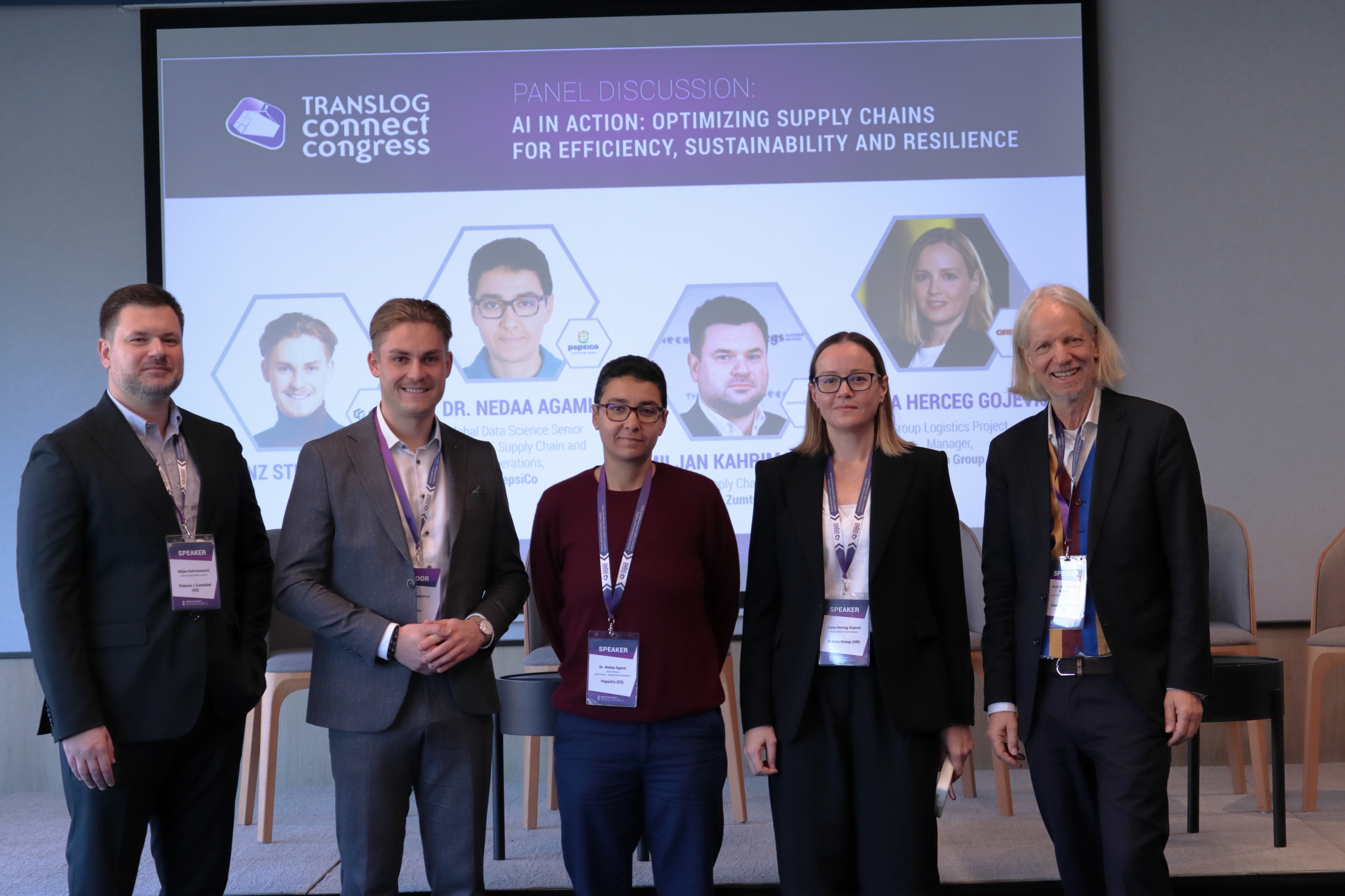
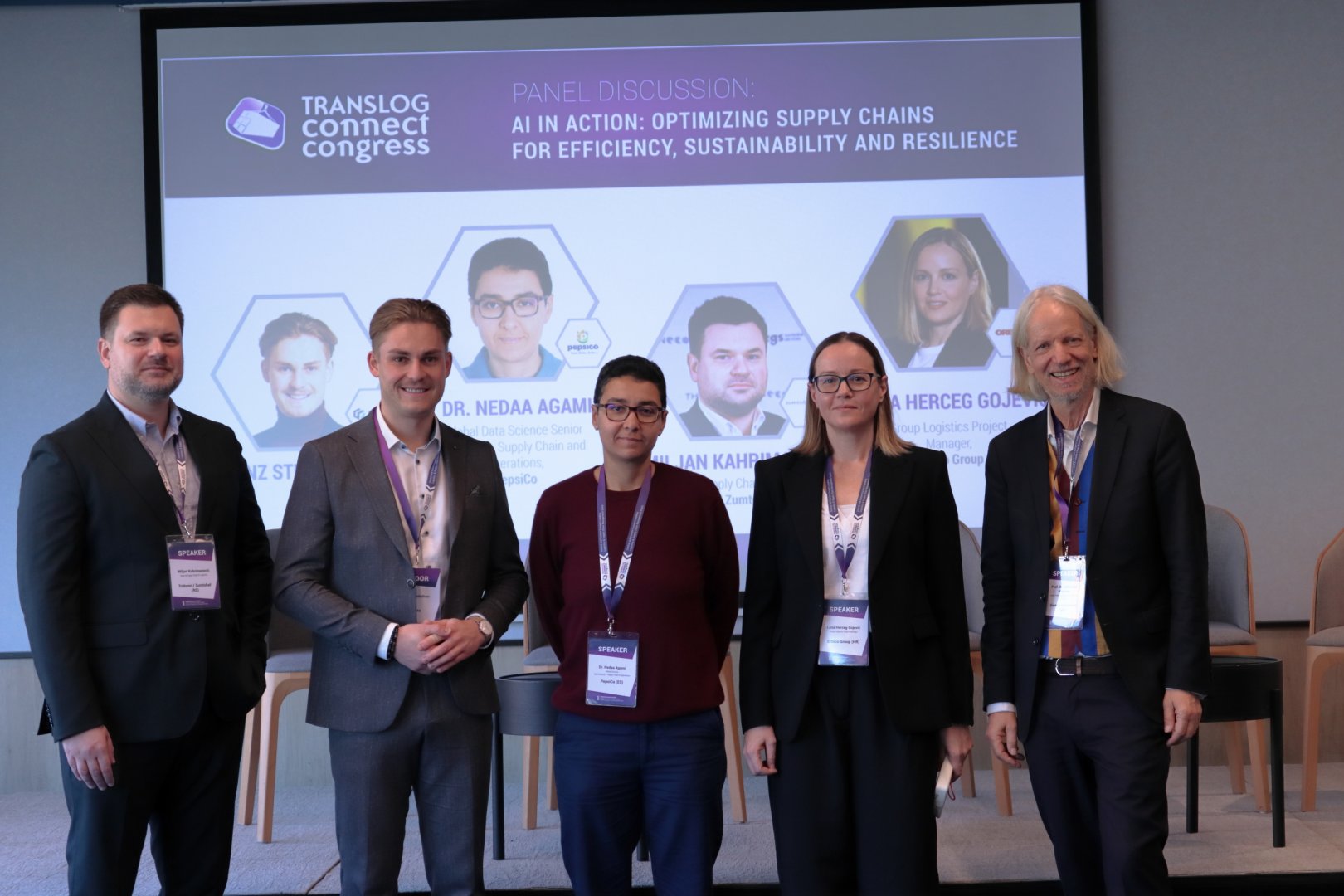
| From left to right Miljan Kahrimanović, Head of Supply Chain & Logistics at Tridonic / Zumtobel Group; Franz Steinkellner, COO of S2data GmbH; Dr. Nedaa Agami, Global Data Science Senior Director at PepsiCo; Lana Herceg Gojević, Group Logistics Project Manager at Orbico Group and Prof. Dr. Sebastian Kummer, Head of the Institute of Transport and Logistics at the Vienna University of Economics and Business (WU) |
.
The discussion brought together Dr. Nedaa Agami, Global Data Science Senior Director at PepsiCo; Miljan Kahrimanović, Head of Supply Chain & Logistics at Tridonic / Zumtobel Group; Franz Steinkellner, COO of S2data GmbH; and Lana Herceg Gojević, Group Logistics Project Manager at Orbico Group. The panel explored how artificial intelligence is enhancing operational efficiency, strengthening resilience, enabling data-driven decision-making, supporting sustainability goals, and reshaping leadership in the AI era.
.
Franz Steinkellner, who also presented AI-supported optimization solutions during the congress, highlighted the importance of specialised algorithm development to improve efficiency and accurately map production and logistics processes. Given that data often originates from multiple corporate sources, data protection and consolidation are critical. Inconsistent or incomplete datasets remain a challenge, which makes data quality and structured integration a priority when designing scalable AI solutions.
Dr. Nedaa Agami also delivered a highly attended, full-house presentation titled “From Hype to Impact: Supply Chain Transformation in the Era of AI,” where she translated strategic AI ambition into measurable operational outcomes. In both her keynote session and the panel discussion, she made it clear that AI itself does not “fix” poor data; sustainable impact depends on robust data governance, well-structured data catalogues, and deliberate strategic choices around training models and organizational readiness. She emphasized that original thinking, domain expertise, and critical judgement must continue to come from people, with AI positioned as an enabler rather than a replacement. A phased implementation approach - supported by targeted employee training, transparent communication, and proactive change management - is essential to ensure that AI investments generate tangible and scalable returns.
Miljan Kahrimanović emphasised that AI should not remain a fashionable expression, but must function as a reliable business tool embedded in daily operations. Within his organisation, AI has already moved beyond experimentation in selected administrative supply chain processes that previously required extensive manual input. Early applications include customs clearance documentation, data validation, and automated summarisation of delivery notes - all supported by clearly defined global procedures and compliance frameworks. Although measurable performance improvements require repeated validation cycles, AI-supported predictive analytics already enables significantly faster access to relevant data compared to traditional planning methods, where market research and forecasting exercises often extended over weeks or even months.
Lana Herceg Gojević echoed the importance of gradual implementation. At Orbico Group, AI adoption was supported through accessible Copilot tools embedded into daily operations. As employees gained confidence and customised solutions to support their workflows, the introduction of more advanced AI functionalities became a natural next step. According to Lana, AI is no longer hype - it has become a time-saving, value-creating habit and part of the “new normal” in everyday operations.
Nedaa also pointed to a less discussed risk: the more companies rely on AI-generated outputs, the less human-generated data may be available. This could eventually lead to feedback loops and biases if not carefully monitored. Continuous oversight and balanced integration are therefore essential.
Franz highlighted the importance of continuous development. Many organisations already use AI routinely, yet expectations for performance improvements - often 20–25% year-on-year - require platforms to evolve accordingly. Trust remains a decisive factor: clearly defined projects, transparent data logic, and strong management alignment are critical for building employee engagement. AI should be positioned as a supportive system that reduces stress and optimises time allocation. Organisations that delay engagement with AI risk weakening their competitive position in an increasingly data-driven market.
At the same time, Miljan underlined that the primary barriers to implementation are not technological, but organisational: education, training, and willingness to adopt new tools. Clear compliance frameworks and structured processes for prompt creation remain essential. Practical demonstrations during training sessions - showing what AI and large language models can achieve with properly structured inputs - are crucial to building internal confidence. Looking ahead three to five years, Miljan sees AI as a powerful support tool for forecasting, daily analytics, and predictive decision-making in volatile sourcing environments. In particular, he highlighted the potential of real-time freight route tracking and more precise lead-time calculations. As transit time estimation by forwarders has become increasingly unreliable in recent years, AI-driven route optimisation could deliver improved door-to-door visibility and more accurate disruption modelling.
In closing, the panelists offered practical advice for organisations beginning or scaling AI adoption in supply chains. Step-by-step implementation, employee involvement, investment in training, strong data quality, and leadership alignment were unanimously identified as decisive success factors.
.
This insightful summary was prepared by Dr. Alexandra Karacs, journalist at NEW Technology Magazine, whose work focuses on digital transformation and emerging technologies shaping the industry across Central and Eastern Europe.
.
As illustrated throughout the discussions, the two-day, business-focused exchange platform’s mission remains consistent: to create a structured environment where the most pressing logistics and supply chain challenges are examined collaboratively - connecting strategic vision with operational reality. The next edition of TRANSLOG Connect Congress will take place on 25–26 November 2026 in Budapest, once again bringing together decision-makers from across Central and Eastern Europe to engage in forward-looking dialogue and foster long-term international partnerships.
.